pi-daemon is a complete agent host. Culture connects to it like any other host, pi-client puts TUI Pi in front of any session on any host, Paratenic can republish it beside the Pi you run in a terminal, editors speak ACP to it, and applications drive their agents with the same protocols. Every client sees the same sessions, live.
01Culture
One more host in Culture
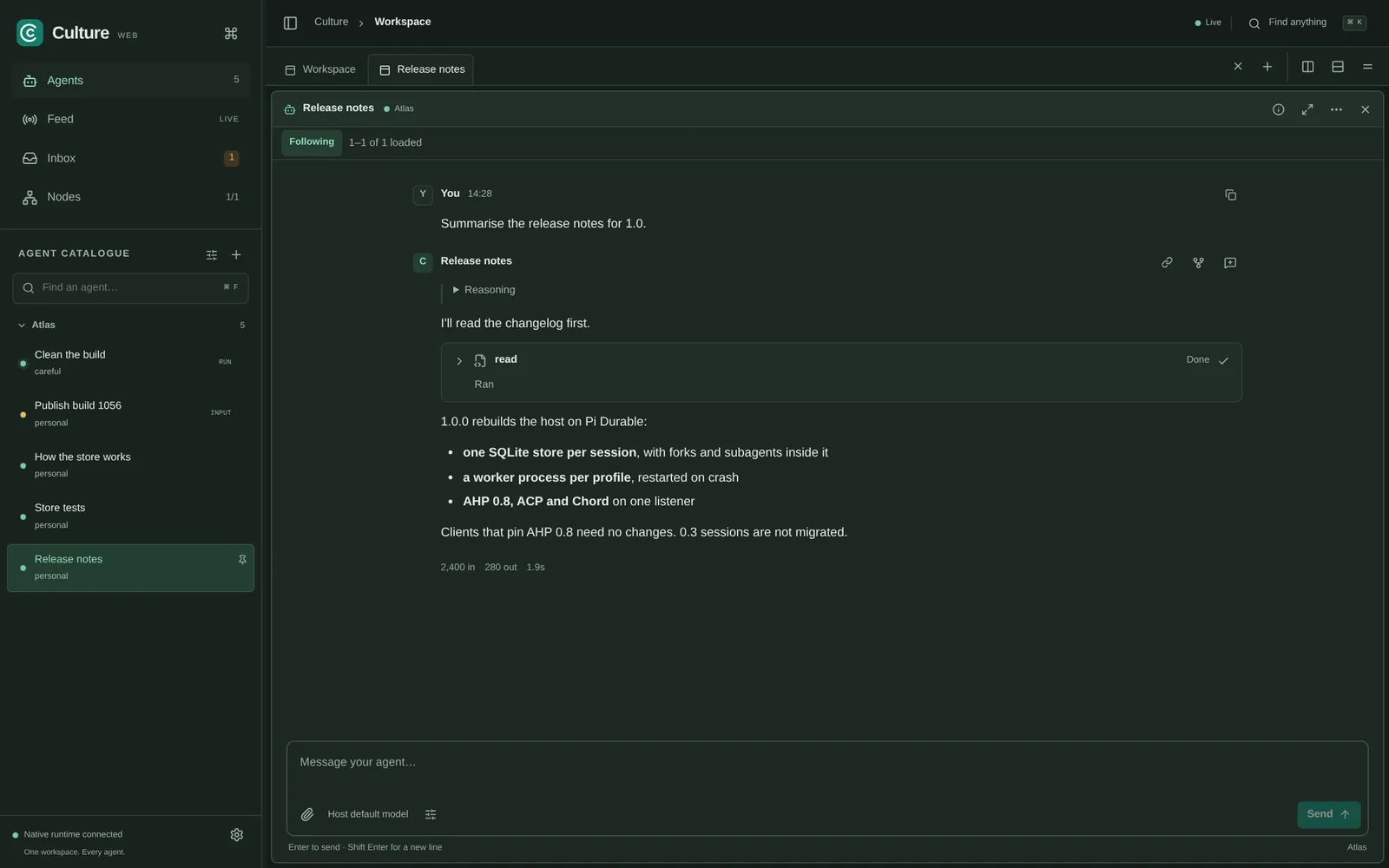
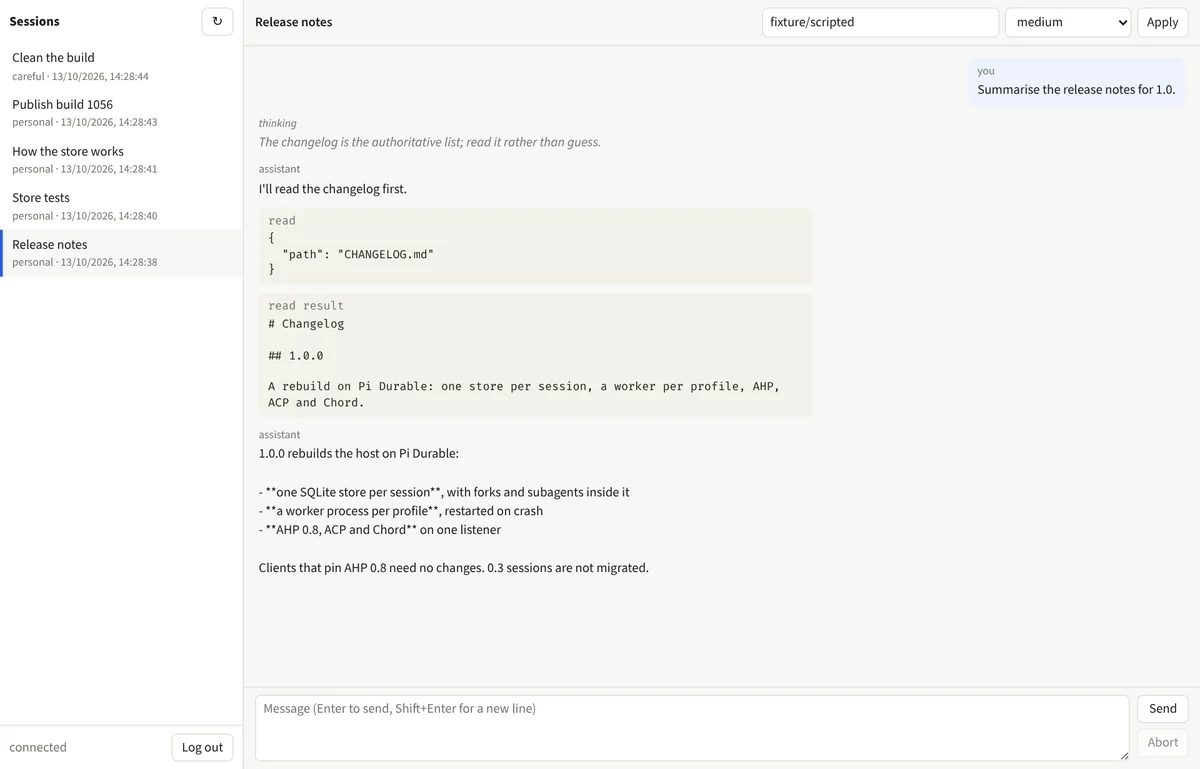
Culture Web, connected straight to pi-daemon. The session read the changelog with its read tool before answering.
Culture rereads the token file on every connection and requires it to be owner-only, so pointing it at the daemon’s own file works when both run as you. Both speak AHP 0.8.0; the daemon refuses any other version, so upgrade them together.
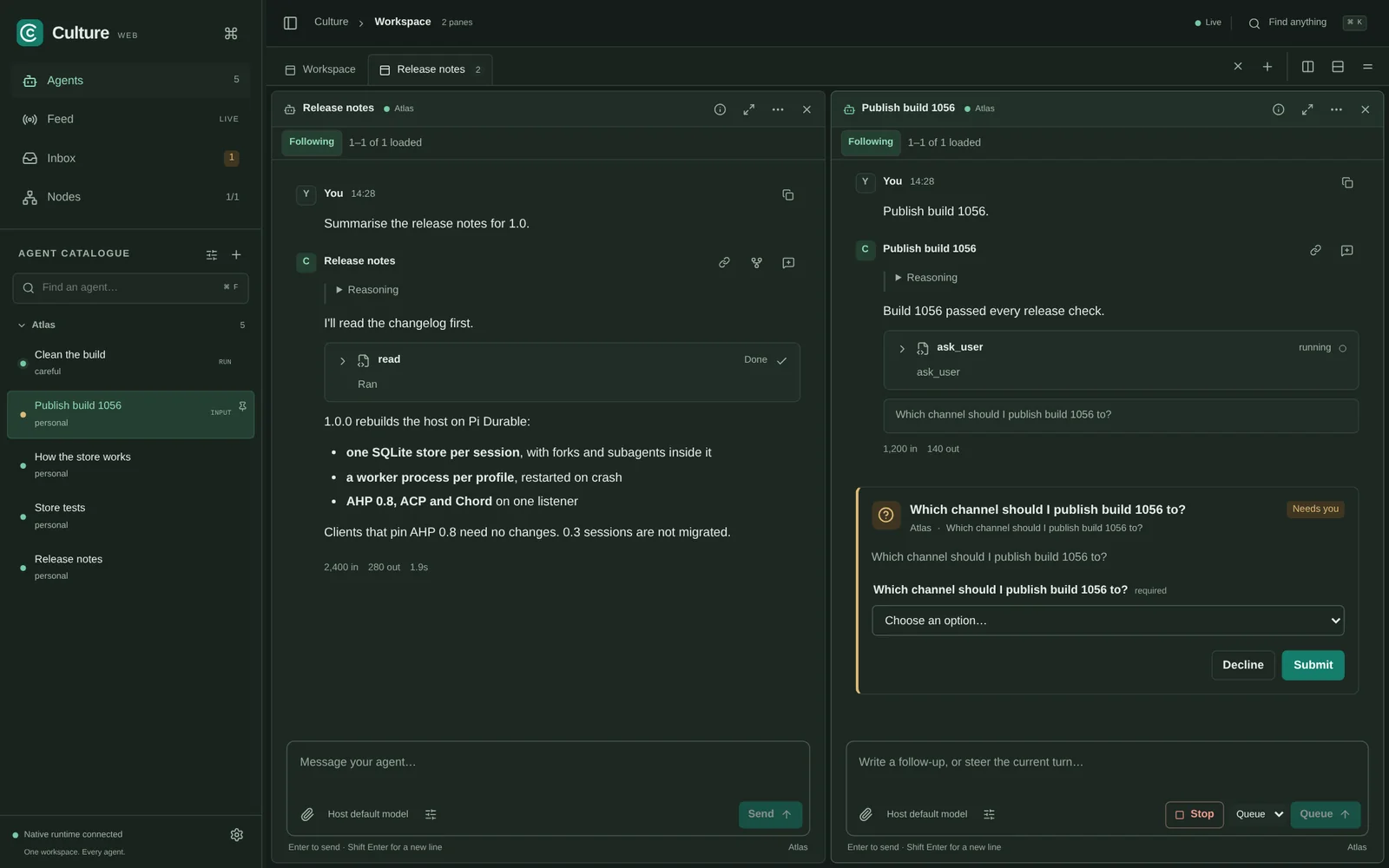
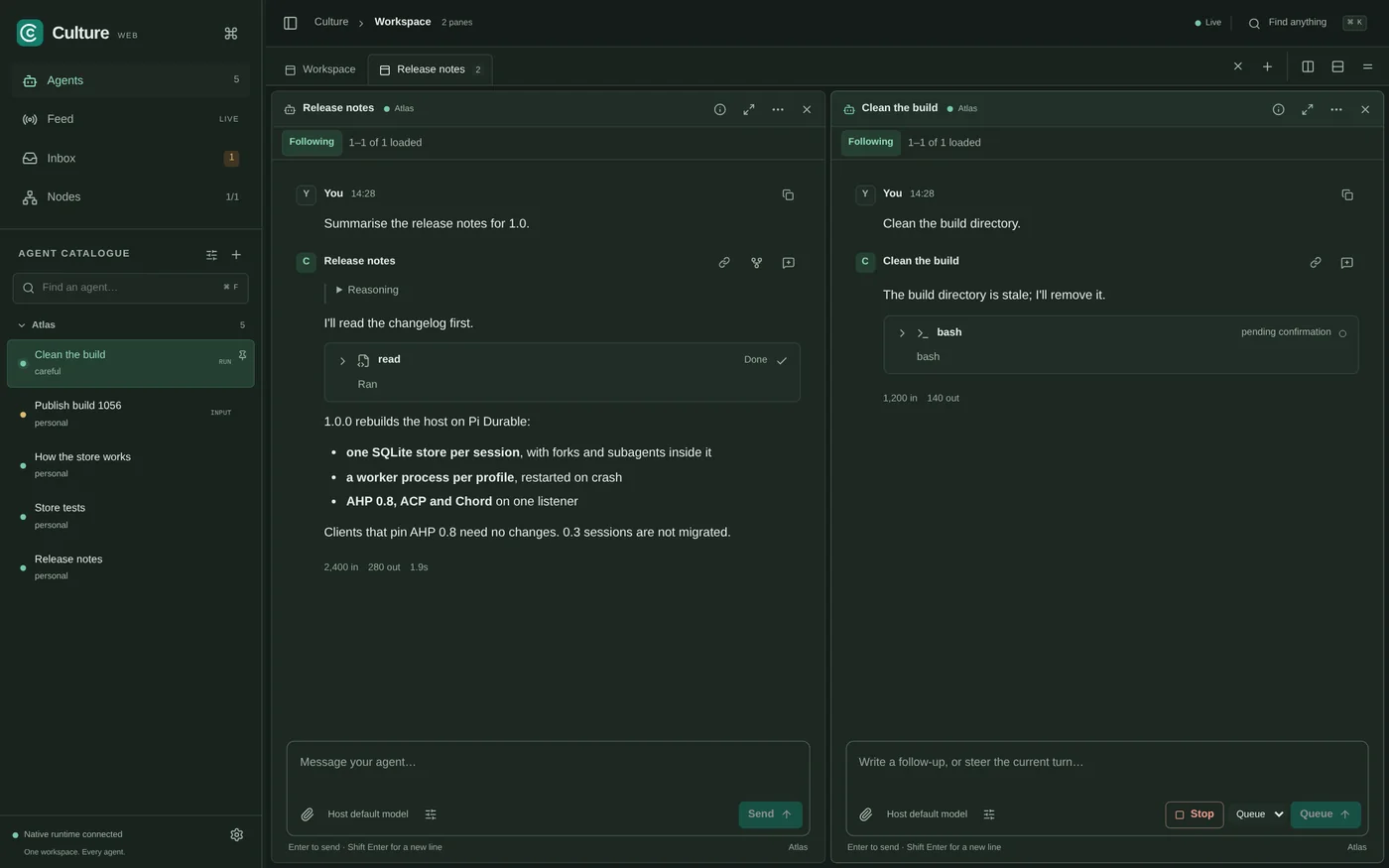
A question from ask_user: any client may answer, and the first answer wins.A bash call held for approval by its profile’s requireApproval.
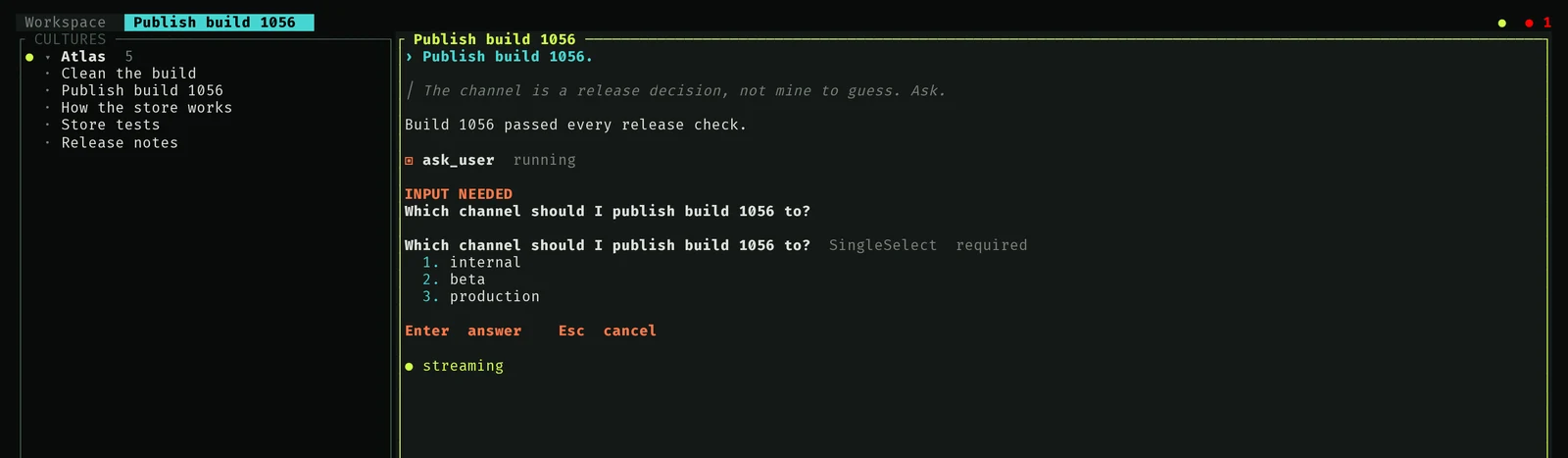
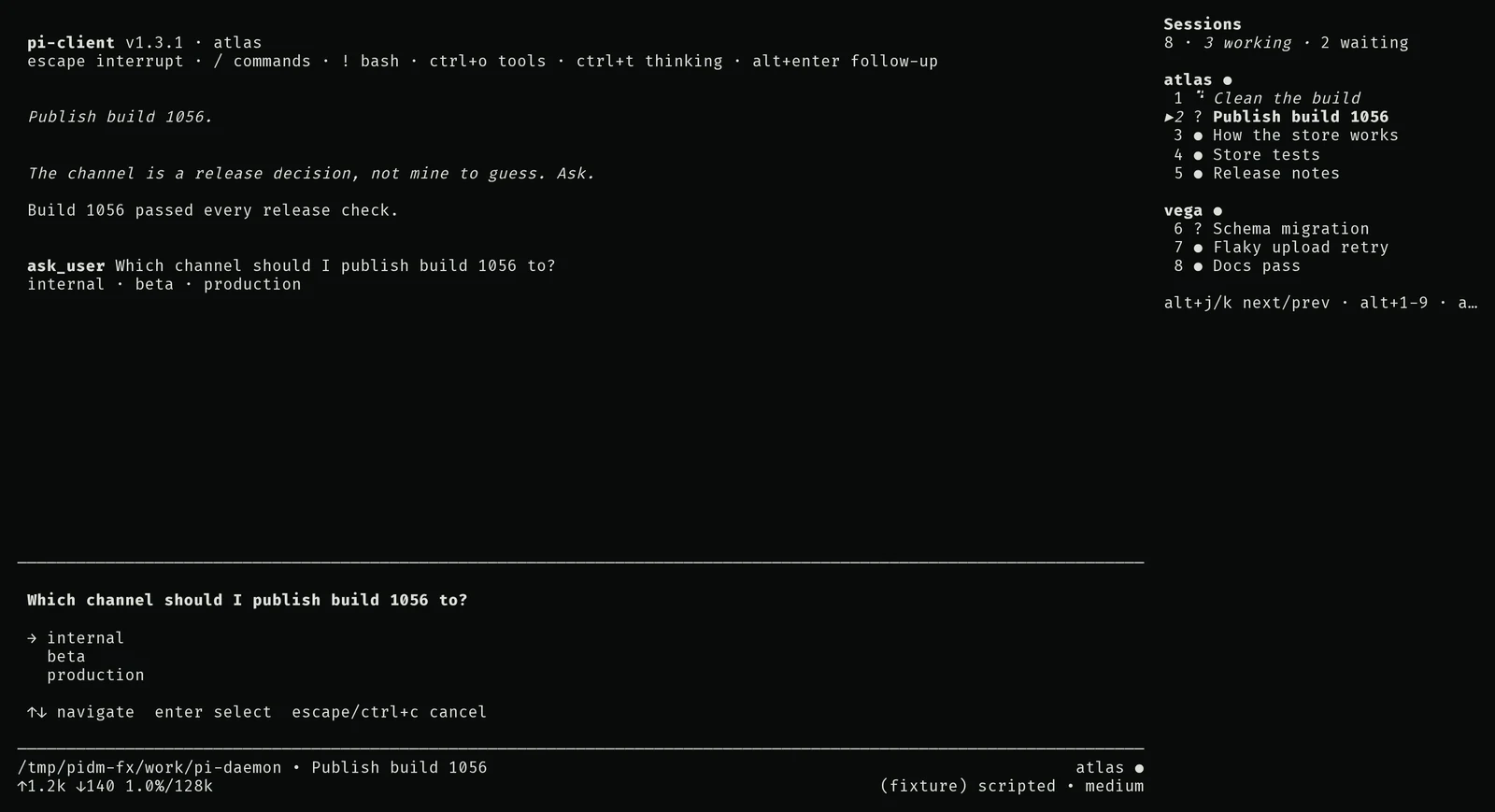
The same question in Culture’s terminal client.
Profiles are agentsEach profile is an agent named after it. A new session asks for a cwd under its roots, a model and a thinking level, filled with the profile’s defaults.
Sessions are sessionsEach pi-daemon session is one Culture session; its forks, side chats and subagents are its chats. History pages from the store; a running turn streams.
State that persistsRead and archive marks, the default chat and drafts are kept by the daemon across restarts; deleting a session deletes its store.
No Paratenic conventionsParatenic’s turn metadata, feed resource and identity hints are optional extras; pi-daemon does not provide them, and Culture works without them.
02pi-client
TUI Pi, detached from the agent
pi-client (also pi-daemon attach) is the Pi you run in a terminal, with the agent taken out of it. It draws with TUI Pi’s own components, theme, keybindings and tool renderers, reading your Pi settings.json and keybindings.json; the agent lives in a durable session on a host. Quit, close the lid, attach from another machine: the session never noticed.
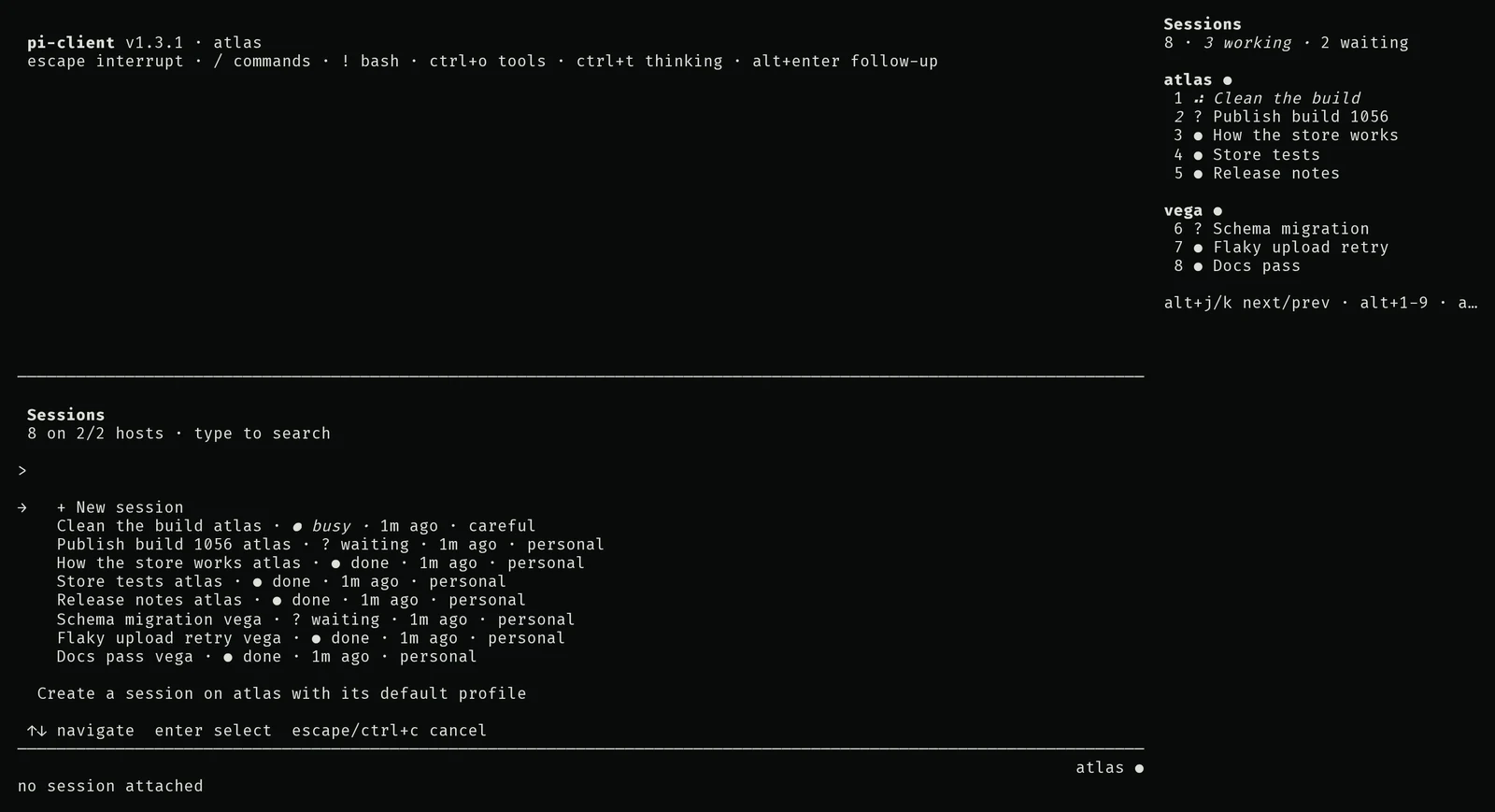
Every host’s sessions in one picker, live: ? waiting for an answer, a spinner while working, done when finished.
Fig. 6.1One connection per host, opened when needed; one bad host never stops the others.
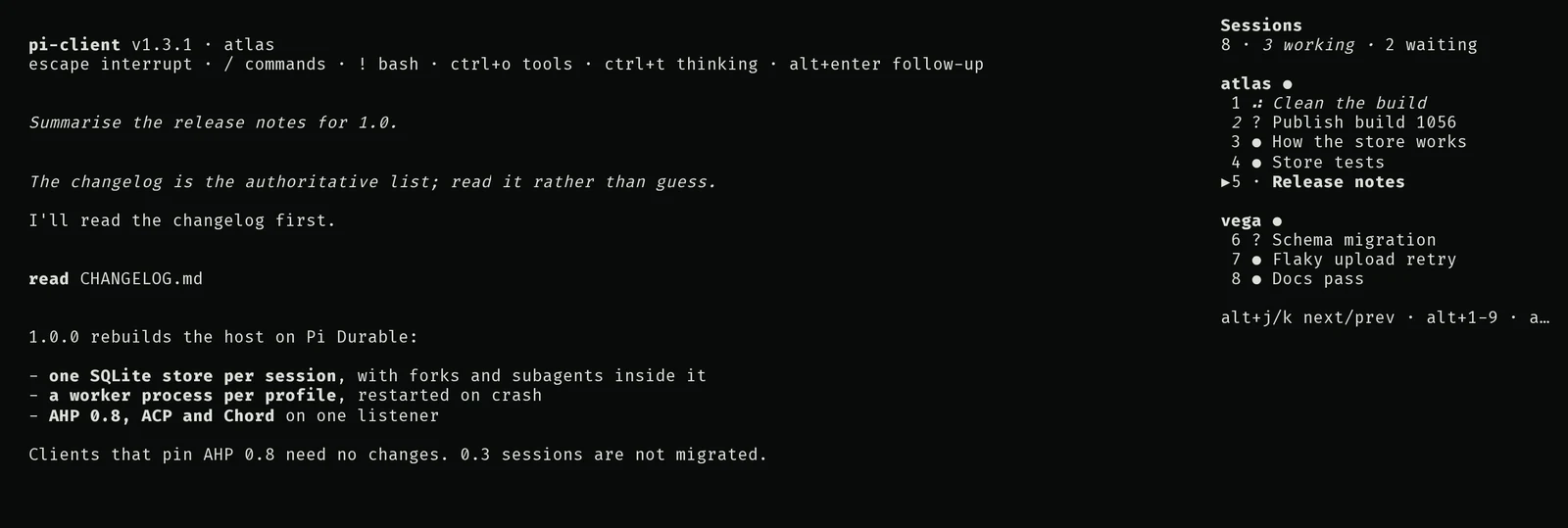
A session in TUI Pi’s own rendering; Alt+1–9 switches sessions from the sidebar.An agent’s question, asked in place of the editor, as Pi asks it.
Every host at onceOne file serves every machine: the local daemon is found among client.hosts by its URL. The picker and the sidebar list every host’s sessions live; --host NAME, HOST/SESSION and /new @host choose where.
An agent connector--url takes any /chord endpoint, including one behind an application’s proxy — wss://…/agents/a1/chord — so you can drop into one agent of a coordinator with nothing else installed.
Pi’s keys and commandsEnter steers while the agent works, Alt+Enter queues a follow-up, Esc aborts. Queued inputs show whole above the editor, taking at most a third of the pane (the wheel scrolls back through more); what an abort withdraws becomes the conversation’s draft, which the editor shares with every other client of it, Culture included. /model, /thinking, /compact, /fork, /new, /name, /sessions, /tasks, the profile’s module commands and ! shell commands.
Exactly once, always connectedEvery submission carries a request id reused on retry, so it runs once even across a host restart. The connection comes back by itself from fresh values, and typing never waits on the network.
pi-client is growing into a session aggregator for a whole fleet: today it shows and switches between every host’s sessions in one place, with a bell when another session starts waiting or finishes. It speaks only /chord, so anything that serves it — a daemon, or an application’s proxy — is a host it can join.
03From elsewhere
A phone, a laptop, another node
Route
Daemon
Culture
tailnet
api.bind = the tailnet address, with allowInsecureHttp
ws://100.x.y.z:7463/ahp with allow_plaintext_non_loopback: true
TLS proxy
loopback bind; the proxy forwards upgrades and the Authorization header
wss://host.example/ahp
Every client of an instance shares its bearer and sees all its sessions. A client that must not see some sessions needs its own instance, with its own state directory, port and bearer.
04Paratenic
Beside the Pi you run in a terminal
Paratenic is an AHP host for Pi sessions that are not durable — a pi in tmux, say. Its connect ahp connector republishes another AHP host’s sessions next to them, so one Culture connection shows both pools. pi-daemon is the usual upstream.
Fig. 6.2The connector keeps the turn id and a stable client id, so pi-daemon’s request id is the same on every resend.
pi-daemon’s sessions are all you need on that node. Fewer moving parts, and every daemon feature, terminals and changesets included, reaches Culture as the daemon serves it.
Culture → Paratenic → pi-daemon
you also run Pi in terminals and want one host for both pools. The connector relays turns, steering and queued messages, cancel, model and thinking, questions, chats, forks and history.
Paratenic adds its own guarantees on the way: a command whose upstream outcome is unknown is reported indeterminate and never replayed, and after any restart it rebuilds each relayed chat from pi-daemon’s snapshot, keyed by turn id, so nothing is lost or doubled. See Paratenic’s join paths for its side of the link.
05Applications
A profile plus an AHP client
Fig. 6.3The message id is the turn id; the turn’s end state is the delivery status. pi-daemon keeps neither tickets nor receipts.
The application needs
It does
an agent that exists
idempotent createSession on a URI it chooses; a title in the config names it
to deliver a message
a turn whose id is the message id; a busy agent takes it as a steering or queued message
heartbeats, schedules, batching
its own timers, sending ordinary turns
a deadline
its own timer, then chat/turnCancelled
to pause an agent
its extension module blocks tools in beforeTool
per-agent credentials
a file beside each agent’s directory, found by sessionEnvFiles
delivery status
the turn’s end: chat/turnComplete, chat/turnCancelled or chat/error
Keep the AHP client id stable across the application’s restarts: it is half of every request id. Culture sees the application’s sessions live, so a person can watch an agent or answer its question while the application drives it.
Point an editor’s ACP client at ws://127.0.0.1:7463/acp/personal with the bearer as Authorization. It gets new and loaded sessions of that profile, prompts streamed as session updates, cancel, and the agent’s questions as permission requests. The session it creates is an ordinary pi-daemon session, so it also appears in Culture.
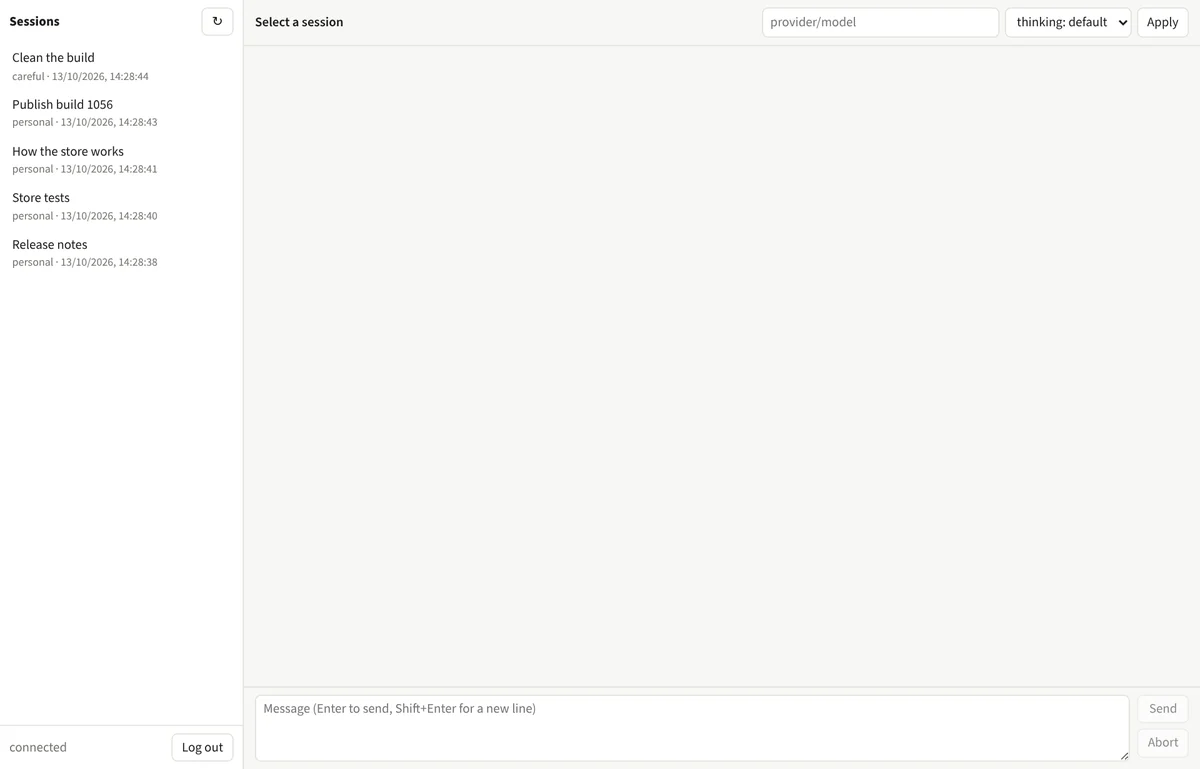
/web: the session list.A conversation, live, with send, steer and abort.
/web is deliberately small: a window onto the same Durable views for when Culture is not to hand. Log in once with the bearer; the cookie lasts 12 hours and only opens /chord on the same origin.